
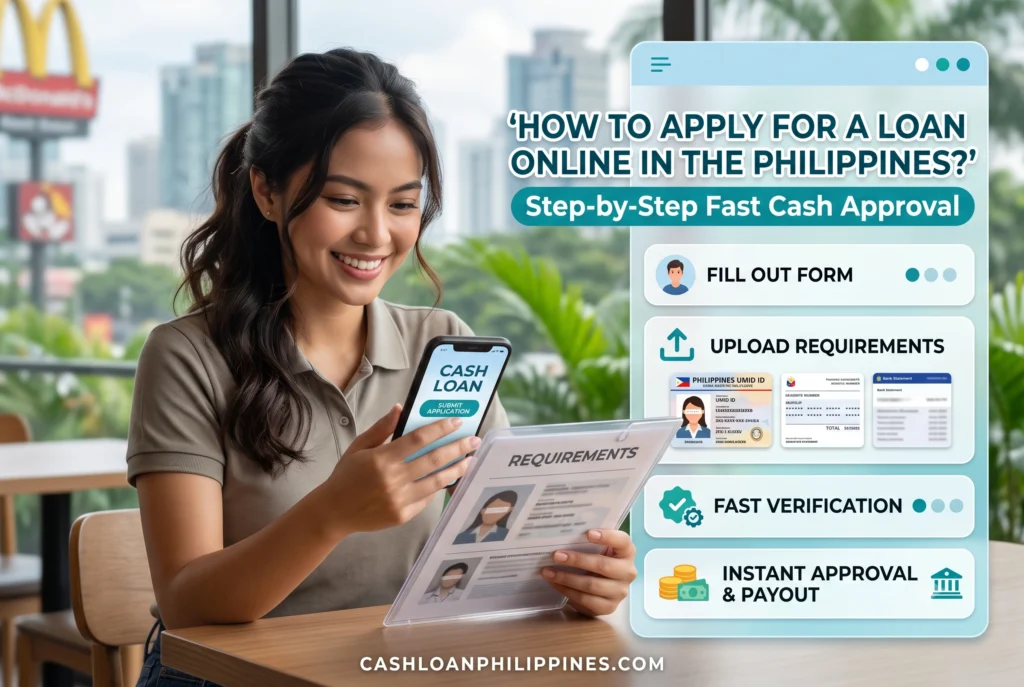
Applying for digital credit in the Philippine market has shifted from a tedious, paperwork-heavy process into a high-speed, algorithm-driven transaction. While the convenience of tapping a mobile screen at 2:00 AM for emergency medical funds is undeniable, the operational reality of securing these funds safely requires strict attention to detail. Digital Lending Apps (DLAs) utilize automated Electronic Know Your Customer (E-KYC) systems, real-time risk assessment, and immediate disbursement networks like InstaPay. However, the rise of predatory platforms masking themselves as legitimate fintech companies means borrowers must navigate this ecosystem with clinical caution, keeping Bangko Sentral ng Pilipinas (BSP) interest rate caps and National Privacy Commission (NPC) data privacy standards top of mind.
Summary:
To safely apply for a loan online in the Philippines, you must first verify the application’s SEC registration to ensure it operates legally. Next, prepare a clear, physical government ID for the E-KYC facial recognition and Optical Character Recognition (OCR) systems. Submit accurate income details to pass automated risk assessment algorithms. Upon approval, funds are typically disbursed via e-wallets or bank transfers in real-time. Borrowers must always review the loan contract for BSP-mandated interest rate caps (maximum 2% per month for micro-loans) and ensure the platform does not demand illegal access to mobile contact lists.
Quick Comparison: Digital Lending Apps vs. Traditional Bank Loans
| Feature | Digital Lending Apps (DLAs) | Traditional Bank Personal Loans |
| Approval Speed | 5 minutes to 24 hours | 5 to 14 banking days |
| Document Requirements | 1 Primary ID, Live Selfie | IDs, ITR, Certificate of Employment |
| Disbursement Method | E-wallets, InstaPay Bank Transfer | Bank account credit, Manager’s Check |
| Credit History Needed? | Minimal (Uses alternative data) | Strict (Requires formal credit score) |
| Maximum Interest Cap | 2% per month (per BSP rules) | ~1.2% to 1.5% per month add-on |
What are the exact requirements to get approved for a digital loan?
To get approved for a digital cash loan, you must be a Filipino citizen aged 21 to 60, possess a physical government-issued ID, and have an active mobile number linked to a disbursement channel. Alternative income proof is required to pass the algorithmic risk assessment.
The threshold for entering the digital lending space is low, but the technological barriers for verification are strict. Fintech platforms do not rely on human loan officers; they rely on automated data point verification. If your inputted data fails to match the extracted OCR data from your documents, the system will automatically flag your profile for rejection.
Which valid IDs do lending apps actually accept?
Digital lending applications universally prioritize the PhilID (National ID), UMID, Driver’s License, and Passport because their standardized formats allow OCR systems to extract data with near-100% accuracy.
A critical point of friction for many borrowers is failing the ID verification stage. When preparing your valid primary IDs, you must understand that the app’s camera is scanning for specific security features, edge borders, and typography. A physical, pristine PhilID or UMID processes through E-KYC systems like those used by legitimate platforms in under five minutes. Conversely, submitting secondary IDs like a PhilHealth card, TIN card, or a heavily faded Postal ID often triggers a manual review pipeline. Manual reviews severely delay the process, turning a supposed five-minute approval into a 48-hour waiting game. Ensure your ID is wiped clean of smudges and that you capture the image without overhead light glare obscuring your birthdate or ID number.
Do I need a bank account to receive my borrowed funds?
No, you do not need a traditional bank account; over 70% of digital micro-loan borrowers choose to receive funds via e-wallets because they offer instant, 24/7 crediting even during bank maintenance hours.
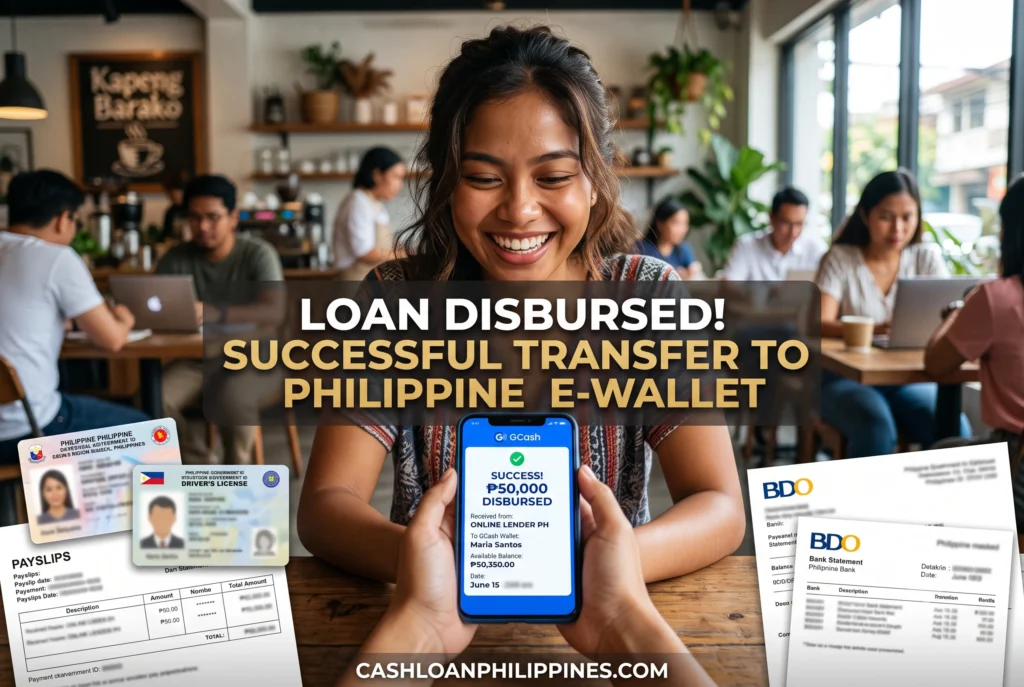
For unbanked individuals, the digital financial ecosystem provides seamless alternatives. If you need immediate liquidity at midnight, you can receive funds via GCash or Maya. Fintech systems utilize InstaPay and PESONet gateways. InstaPay processes transactions in real-time up to ₱50,000, which aligns perfectly with the typical micro-loan ticket size in the Philippines. However, ensure that the mobile number registered on your lending app matches the exact mobile number tied to your fully verified e-wallet. A mismatch in mobile numbers or registered names will cause the disbursement to bounce back, locking your loan in a pending state while interest technically begins to accrue.
How do you safely process your digital loan application from start to finish?
A safe application process involves checking the SEC list of registered lending companies, denying the app access to your private contacts, completing the E-KYC facial liveness check, and signing a transparent digital contract.
The actual process of tapping through an app is simple, but the defensive actions you take during this process dictate your digital safety. Borrowers often skip reading the permission prompts during installation, inadvertently granting predatory apps access to their phonebooks—a direct violation of NPC data privacy guidelines.
How do you spot a fake lending app before downloading?
You can spot a predatory lending app by checking if it demands access to your contact list, charges hidden processing fees upfront, or fails to appear on the official SEC list of registered lending companies.
The most crucial step before downloading any software is to verify SEC registration. The Securities and Exchange Commission (SEC) maintains a publicly accessible, frequently updated list of registered lending and financing companies. If an app is not on this list, it is operating illegally. Furthermore, apply NPC safety checks during installation. A legitimate financial app only needs access to your camera (for E-KYC) and location (for fraud prevention). If an app requests permission to view your contacts, SMS history, or photo gallery, deny the permission and uninstall it immediately. Predatory lenders harvest this data to harass your family and colleagues if you miss a payment.
What is the fastest way to pass the E-KYC and facial recognition step?
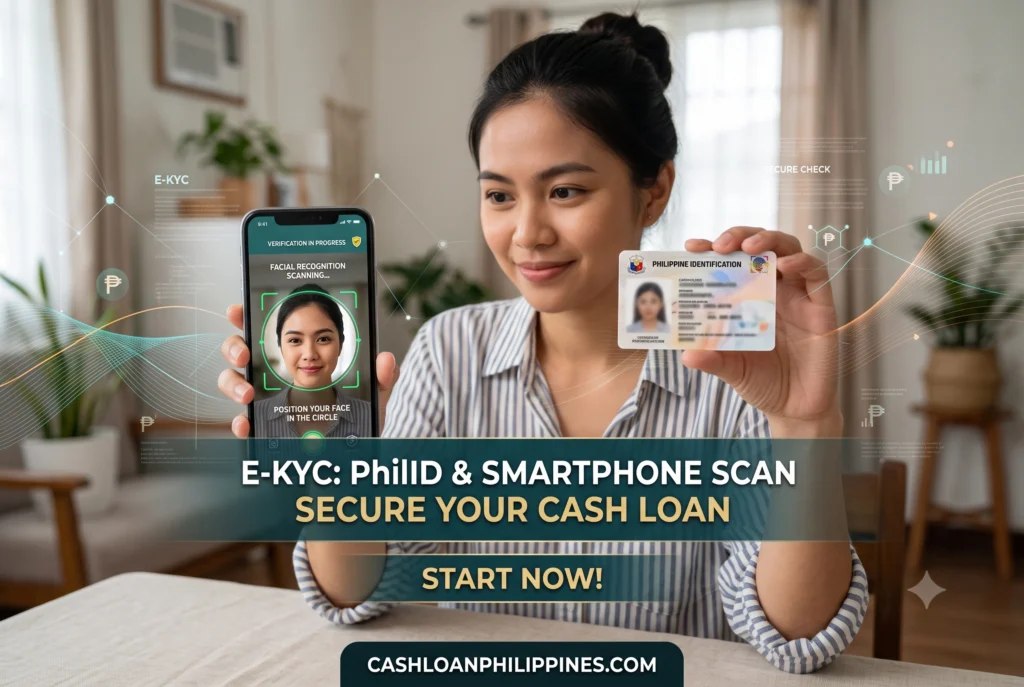
To instantly pass E-KYC facial recognition, perform the liveness check in a well-lit room against a plain background, ensuring your facial angles strictly match the photo on your submitted government ID.
Liveness checks prevent fraudsters from using static photos or deepfakes to steal identities. The app will ask you to blink, turn your head, or smile. What many borrowers do not realize is that the system maps your facial biometrics against the 2D image of the ID you uploaded moments prior. If you apply wearing thick glasses, a cap, or in heavy shadow, the biometric matching confidence score drops below the threshold, resulting in an automatic denial. Remove all facial accessories, wipe your front camera lens, and ensure the lighting is directly in front of your face, not behind you.
How long does it take for the digital disbursement to reflect?
Legitimate digital loans processed through InstaPay will reflect in your e-wallet or bank account within three to five minutes after you digitally sign the loan contract.
The speed of modern lending is driven by API integrations between the DLA and the banking sector. Once your credit profile clears the risk engine, the disbursement is entirely programmatic. However, borrowers must be aware of systemic downtimes. If you apply during the core banking maintenance window (typically between 10:00 PM and 2:00 AM on weekends), your InstaPay transfer might float in the banking gateway until the next morning. Always check your e-wallet platform for maintenance advisories before executing a time-sensitive loan contract.
Can I still get an online loan if I don’t have a regular corporate job?
Yes, gig economy workers and self-employed individuals can secure digital loans because fintech risk algorithms analyze alternative data points, mobile behavior, and digital transaction history rather than demanding a traditional Certificate of Employment.
The Philippine workforce is heavily decentralized, with millions engaged in freelance work, online selling, and informal gig setups. Traditional banks view this demographic as high-risk due to fluctuating income. Digital lenders, however, have optimized their credit models to serve this exact segment, provided the applicant can prove cash flow through alternative means.
What is the process when applying for a cash loan as a freelancer or gig worker?
Freelancers must link their active e-wallet transaction history, provide screenshots of consistent platform earnings (like Upwork or Grab driver wallets), or sync their digital banking activity to prove cash flow.
When applying as a freelancer, you bypass the traditional requirement of corporate payslips. Instead, fintech platforms use open banking or require you to upload proof of consistent income over the last 90 days. If you are an online seller, your GCash transaction volume serves as your creditworthiness metric. The system looks for stability. A freelancer with a steady weekly influx of small payments is scored higher than an applicant who receives one massive, unexplainable deposit every six months. Keep your digital financial records clean and centralize your business income into a single digital wallet to build a robust alternative credit profile.
How do platforms evaluate borrowers with zero formal credit history?
Fintech risk engines evaluate thin-file borrowers by analyzing device fingerprinting, location stability, app usage behavior, and the consistency of the data entered during the application phase.
If you do not exist in the Credit Information Corporation (CIC) database, DLAs use metadata to determine your trustworthiness. Device fingerprinting checks if your smartphone has been associated with previous fraudulent loan defaults. Risk engines also measure behavioral friction—if you take too long to type your own address, or if you repeatedly copy-paste your personal details, the algorithm flags this as suspicious behavior typical of identity thieves. Filling out the form smoothly, using a device with a stable network connection, and providing a residential address that matches your geolocation data significantly boosts your approval odds.
Why do lending apps reject applications and how can you fix them?
Applications are rejected due to ID OCR failures, mismatched registration data, hidden existing defaults in the credit registry, or triggering the app’s internal fraud detection parameters.
Rejection from a digital platform is rarely personal; it is purely mathematical. Because there is no human intervention during the initial screening, the slightest typographical error or technical glitch can terminate your application.
What are the most common reasons your profile gets denied?
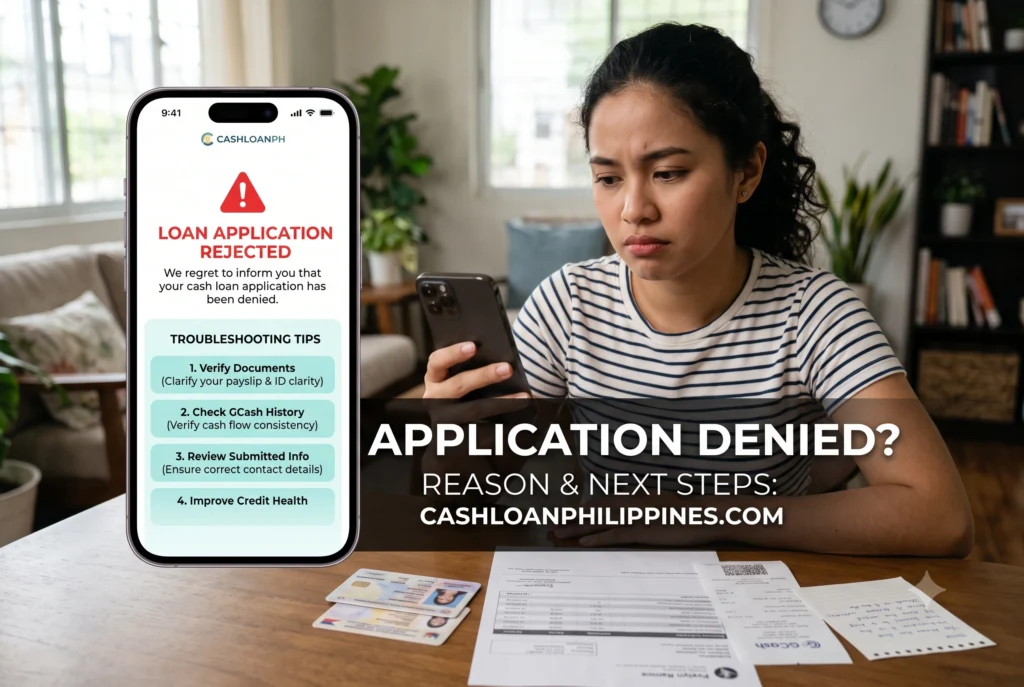
The primary triggers for instant denial include uploading a blurry ID, typing a name that does not perfectly match the ID, or inputting an e-wallet number registered to a different individual.
Operational bottlenecks usually occur at the data-entry level. If your PhilID says “Ma. Cristina” but you type “Maria Cristina” into the app, the text-matching algorithm will return a negative result. Similarly, if your reported monthly income is disproportionately low compared to the loan amount you are requesting, the debt-to-income ratio parameter will automatically block the release of funds. Furthermore, major DLAs now actively pull data from the CIC. If you defaulted on a different SEC-registered app three months ago, that delinquency is visible to your current prospective lender.
What should you do to troubleshoot a rejected application?
To fix a rejected application, you must wait out the platform’s mandatory cooling-off period (usually 30 days), re-capture your ID in better lighting, and double-check exact name matching across all linked accounts.
When you need to troubleshoot a rejected application, immediately firing off a second attempt on the same app will trigger a spam-lock on your device. Instead, identify the point of failure. Did the app reject you immediately after the ID scan? The issue is visual clarity. Did it reject you right before disbursement? The issue is likely a mismatch between your registered app name and your GCash/Maya account name. Correct these data points before the cooling-off period expires.
What are the best strategies to guarantee instant approval next time?
To maximize your approval chances, maintain a single active mobile number for all financial transactions, ensure your e-wallet is fully verified, and borrow a small initial amount to establish internal platform trust.
The most effective strategies for instant approval revolve around establishing digital consistency. Algorithms love predictable data. Use the exact same mobile number for your Shopee, Grab, Maya, and digital lending accounts. This creates a highly verified digital footprint. Furthermore, do not request the maximum loan limit on your first try. If the app offers up to ₱10,000, request only ₱3,000. Risk engines are programmed to approve lower initial amounts to test borrower repayment behavior. Once you repay the first micro-loan on time, the system will automatically upgrade your credit tier, unlocking higher limits and lower interest rates for future needs.
Conclusion
Successfully securing an online loan in the Philippines is no longer about sitting in front of a bank officer; it is about proving your credibility to a digital system. By preparing the correct high-quality IDs, managing your alternative income data, and strictly utilizing e-wallets that match your verified identity, you can move from application to disbursement in a matter of minutes. However, the speed of digital finance should never override your personal security. Always verify the platform’s SEC registration, protect your mobile data privacy against predatory permissions, and carefully calculate the BSP-capped interest rates before electronically signing any contract. Borrowing online is a powerful financial tool when used responsibly and executed safely.
References
- Bangko Sentral ng PilipinasOrganization: BSPResource: Issuances on Interest Rate Caps (Circular No. 1133)URL: https://www.bsp.gov.ph/
- Securities and Exchange Commission PhilippinesOrganization: SEC PhilippinesResource: List of Registered Online Lending PlatformsURL: https://www.sec.gov.ph/
- National Privacy CommissionOrganization: NPCResource: Advisories on Data Privacy in Online Lending ApplicationsURL: https://www.privacy.gov.ph/
- Credit Information CorporationOrganization: CICResource: Borrower Credit Report and Data Submission GuidelinesURL: https://www.creditinfo.gov.ph/
Community & User Experience Sources
- Reddit Philippines (r/phinvest)Organization: RedditResource: Community Discussions on Digital Lending App Rejections and Best PracticesURL: https://www.reddit.com/r/phinvest/
Last Updated on October 2, 2026 by Maria Santos
