
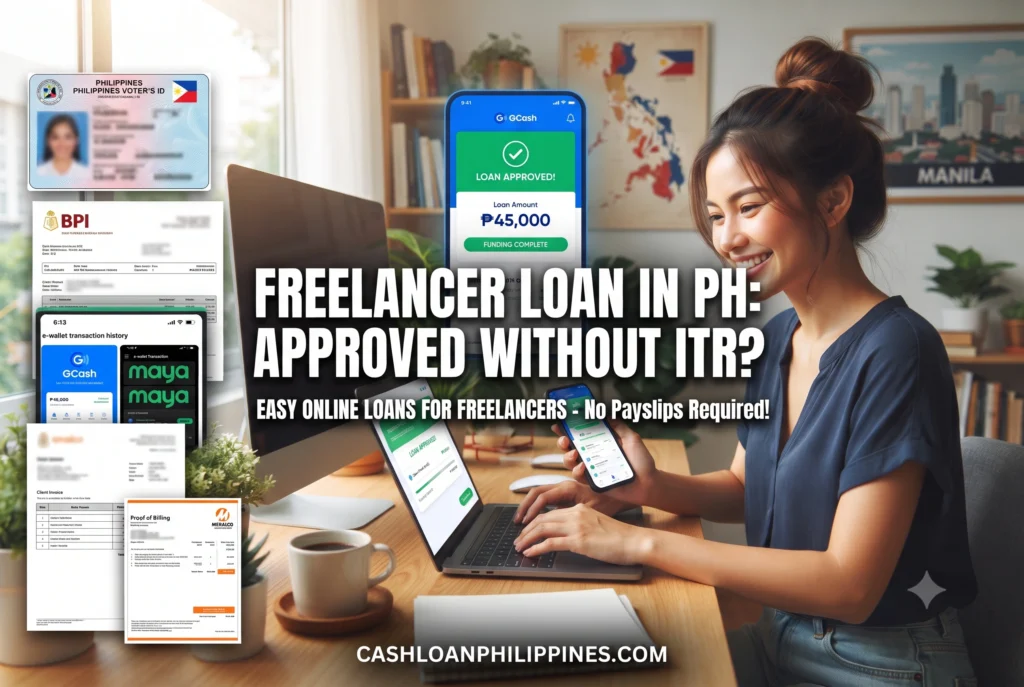
The Philippine labor market relies heavily on independent digital labor. Millions of Filipinos generate substantial foreign currency working as virtual assistants, independent contractors, or creatives. Despite earning stable, often above-average income, these professionals face immediate friction when accessing formal credit. Traditional commercial banks require corporate payslips and structured tax documents, heavily penalizing workers operating outside standard employment frameworks. Digital fintech lenders bridge this gap, utilizing alternative data and dynamic verification systems to evaluate creditworthiness. Passing these automated checks requires strict attention to document formatting, algorithmic behavior, and systemic application requirements.
Summary:
Securing an online loan for freelancers in the Philippines requires presenting alternative income proof since standard corporate payslips are unavailable. Fintech lending apps evaluate gig economy credit scoring using digital transaction histories, banking algorithms, and official regulatory registrations. Freelancers can leverage Upwork Certificates of Earnings, PayPal statements, Payoneer transaction logs, and remittance slips to pass eKYC verifications. By formatting documents as clear, vector-based PDFs rather than compressed mobile screenshots, independent workers successfully bypass automated OCR rejections. Proper DTI registration and filing BIR Form 1701 further legitimize non-standard income, ensuring faster approvals and larger credit limits.
| Requirement Category | Standard Corporate Employee | Freelancer / Gig Worker Alternative | Verification Success Rate |
| Primary Income Proof | Corporate Payslip (1-3 months) | Upwork Certificate of Earnings, Fiverr Revenue Log | High (if exported as official PDF) |
| Banking Record | Payroll Bank Statement | PayPal / Payoneer Transaction History | High |
| Tax Documentation | BIR Form 2316 | BIR Form 1701 | Very High |
| Employment Verification | Certificate of Employment (COE) | DTI Business Registration | Medium to High |
| Cash Transfers | Not Applicable | Remittance Slips (Western Union, MoneyGram) | Medium (Subject to manual review) |
Why Do Lending Apps Auto-Reject Freelancers, and How Can You Avoid It?
Fintech lending apps auto-reject freelancers because automated OCR algorithms cannot extract data from blurry screenshots or informal dashboards. You can avoid this by submitting official, system-generated PDFs that algorithms can parse instantly.
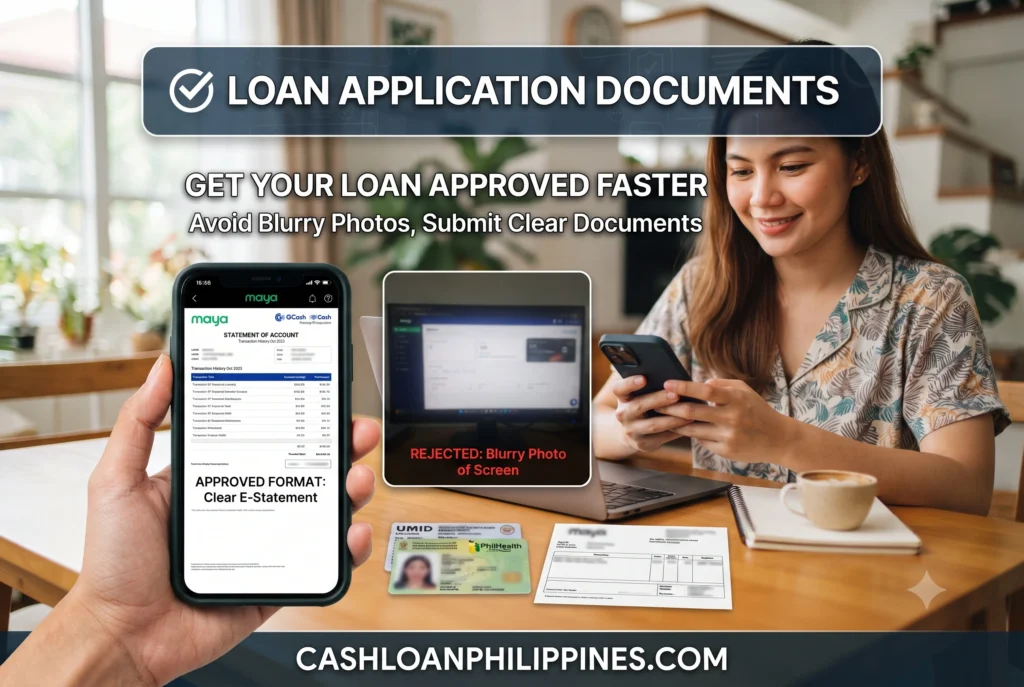
Digital lending platforms process thousands of applications hourly. To maintain efficiency, they rely on automated Optical Character Recognition (OCR) software to read and verify uploaded documents. When an independent worker takes a physical photo of a computer screen showing their earnings, the resulting image contains pixelation, screen glare, and distorted text. The OCR system cannot read this unstructured data, immediately categorizing the application as unverifiable or fraudulent. Avoiding this requires understanding how the software consumes data.
How Do Fintech Credit Scoring Algorithms Evaluate Gig Economy Income?
Credit scoring algorithms assess gig economy income by analyzing deposit frequency, transaction consistency, and the digital footprint of e-wallet usage. Regular, predictable inward remittances score higher than sporadic, lump-sum transfers.
Unlike traditional banks that verify fixed monthly salaries, digital lenders assess cash flow velocity. The gig economy credit scoring model looks for patterns. If a borrower receives bi-weekly payments from a foreign client, the algorithm flags this as recurring revenue. Consistency heavily outweighs the total volume of money. A freelancer earning PHP 30,000 consistently every two weeks presents a lower risk profile than a consultant who receives a single PHP 150,000 payment once every four months. Structuring your withdrawals to hit your local bank or e-wallet on a predictable schedule trains the lender’s algorithm to view you as financially stable.
Why Do OCR Algorithms Reject Your Upwork or PayPal Screenshots?
OCR algorithms reject screenshots because image compression distorts text borders and removes verifiable file metadata. Submit native PDFs so the system can verify authenticity without triggering fraud-prevention flags.
When you snap a screenshot on your phone, the device compresses the image into a JPEG. This compression creates microscopic blurring around the edges of text characters. When a Philippine lending app scans this image, the text recognition software struggles to differentiate an “8” from a “3” or a “0” from an “O.” Furthermore, screenshots lack the embedded metadata found in system-generated documents. Lenders utilize metadata to verify that a document has not been altered using editing software.
What Are the Best Alternative Proofs of Income for Virtual Assistants and Independent Contractors?
The best alternative income proofs are digital platform certificates, verified e-wallet transaction histories, and formalized tax registrations. These documents replace traditional corporate payslips by providing verifiable, third-party financial data.
Independent contractors must replace the traditional Certificate of Employment (COE) with verifiable digital footprints. Regulated fintech platforms actively accept alternative documents provided they originate from recognized global payment gateways or established freelance marketplaces. The objective is to prove that the income is actively generated, legally acquired, and consistently disbursed.
How Do You Format an Upwork Certificate of Earnings for eKYC Systems?
Format your Upwork Certificate of Earnings by downloading the native PDF directly from your user dashboard. Never submit a mobile screenshot, as eKYC systems require the embedded digital signature for validation.
Upwork provides a built-in feature specifically designed for independent workers needing financial documentation. Navigate to your dashboard, select the ‘Reports’ tab, and generate the Certificate of Earnings. This document includes your name, profile address, and a certified breakdown of your historical revenue. Because this file is a vector-based PDF, the text remains perfectly crisp regardless of how the lending app’s system processes it. The embedded digital signature acts as a trust signal to the lender’s risk department, proving the document was generated directly by the platform and not fabricated.
Can I Get an Online Loan Without an ITR by Using PayPal or Payoneer Transaction Histories?
Yes, you can secure digital credit without an ITR by submitting 90-day PayPal or Payoneer transaction logs. Lenders analyze these statements to verify sustained cash flow from foreign clients.
Failing to present an Income Tax Return (ITR) is the primary reason banks deny self-employed applicants. Digital platforms bypass this requirement by examining your payment gateways. When submitting PayPal or Payoneer records, export the 90-day transaction history as a CSV or PDF file. Highlight the incoming transfers from your specific clients while leaving outgoing personal expenses visible. Lenders need to see the entire financial ecosystem – not just the income, but how you manage your liquidity.
How Should You Prepare Your Bank Statements and Remittance Slips for Loan Approval?
Prepare your financial documents by generating official three-month electronic bank statements and keeping high-resolution copies of remittance receipts. Ensure all reference numbers are legible for manual and automated cross-referencing.
A robust digital paper trail prevents manual review delays. When fintech risk officers or automated systems evaluate an application, they look for cross-verifiable data points. If you claim you earn money via a BPO agency but your bank statement shows zero inward transfers matching that claim, the application fails. Proper preparation aligns your stated income with your actual banking behavior.
Do Lending Apps Accept Remittance Slips as Valid Income Proof?
Yes, many Philippine lending apps accept remittance slips, provided they show consistent inward transfers. The slips must clearly display the MTCN, sender details, and transaction dates to satisfy KYC requirements.
Many remote workers receive salaries through Western Union, MoneyGram, or similar remittance centers. While digital banks prefer electronic transfers, many mobile lenders accept remittance receipts. The critical factor is legibility. Faded thermal receipts will fail the validation process. Take clear, well-lit photographs of these slips immediately after receiving them. The verification team will cross-reference the sender’s details and the Money Transfer Control Number (MTCN) to validate the cash flow.
How Do Bank Statement Algorithms Analyze Freelance Deposits?
Bank statement algorithms scan for recurring deposit keywords, average daily balances, and minimal overdrafts. They prioritize borrowers who maintain stable balances rather than those who immediately withdraw all incoming funds.
Fintech applications connect to banking APIs or require PDF statement uploads to run behavioral analysis. The algorithm scans the descriptions of your incoming funds. Labels like “Payroll,” “Transfer from PayPal,” or “Upwork Escrow” act as positive triggers. The system also calculates your Average Daily Balance (ADB). If you receive PHP 50,000 on a Monday and your balance drops to zero by Tuesday, the system flags high financial distress. Keeping a small, stable buffer in your account dramatically improves your risk score.

What Regulatory and Legal Documents Can Boost a Freelancer’s Approval Odds?
Securing local regulatory documents formalizes your independent labor, immediately elevating your creditworthiness. Presenting these official government records separates you from high-risk, unverifiable applicants in the lender’s risk assessment models.
While you can secure micro-loans using just basic IDs and alternative data, accessing larger capital requires formalization. Fintech platforms operating under the Bangko Sentral ng Pilipinas (BSP) have strict anti-money laundering (AML) quotas. Providing government-backed business registrations proves your freelance operation is a legitimate, taxable entity, unlocking premium credit tiers.
Does DTI Registration Make It Easier for Self-Employed Earners to Get Credit?
Registering with the DTI reclassifies a freelancer as a legitimate sole proprietor in the eyes of financial institutions. This drastically reduces perceived lending risk and unlocks higher credit limits.
Acquiring a Department of Trade and Industry (DTI) Certificate of Business Name Registration is a fast, entirely online process. By registering your freelance services as a sole proprietorship, you transition from a “non-standard earner” to a “business owner.” When a lending algorithm detects a valid DTI certificate, it applies a different, more forgiving risk matrix to your profile. This documentation proves permanence and professional intent.
How Can BIR Form 1701 Substitute for Corporate Payslips?
BIR Form 1701 serves as a definitive, government-backed record of annual income for mixed-income earners and self-employed professionals. It provides identical legal weight to a standard corporate BIR Form 2316.
Filing taxes as a freelancer establishes undeniable financial legitimacy. BIR Form 1701 (Annual Income Tax Return for Individuals) acts as the ultimate trump card for credit applications. When an independent worker uploads a stamped BIR Form 1701, digital lenders immediately verify the declared income against the requested loan amount. This document removes all algorithmic doubt regarding your earning capacity, often resulting in instant approval and lower interest rates.
How Does a Freelancer Overcome Verification Bottlenecks in Real Life?
Borrowers overcome verification failures by systematically identifying the reason for rejection, correcting document formatting, and selecting platforms tailored to independent contractors. Proper preparation prevents getting flagged by anti-fraud systems.
Failing a digital application is frustrating, but it is rarely permanent. Automated systems operate on strict binary rules. If a parameter is missed, the system stops the process. Recovering from a rejection requires a calm, analytical approach to your application data.
What Should a BPO Independent Contractor Do When eKYC Fails?
When eKYC fails, a BPO independent contractor should immediately verify the lighting on their physical ID and ensure their face matches the biometric scan. Faded physical cards usually require manual intervention.
Electronic Know Your Customer (eKYC) relies heavily on facial recognition and ID scanning. If you are applying using an older UMID card with faded edges, the system will reject it, suspecting tampering. Do not panic if this happens. Move to a space with natural sunlight, wipe the camera lens, and ensure there is no glare obscuring the holographic seals on your ID. If automated failure persists, switch to a high-quality physical ID like a recent PhilSys National ID or Passport, which OCR systems process with a near 100% success rate.
How Do You Apply When Funding Urgent Equipment Repairs?
When a freelance graphic designer needs funds to upgrade a broken laptop, they must bypass strict banks and utilize fintech apps with alternative data scoring. Preparation ensures rapid digital disbursement.
Consider a freelance graphic designer working a time-sensitive client contract when their primary laptop motherboard fails. Standard bank loans take five to seven business days for processing, which means losing the client. Instead, the freelancer gathers their exported Upwork PDF certificates, a clear photo of their PhilSys ID, and a 90-day PDF of their bank statement. When you are ready to start your online loan application, ensure all these files are stored directly on your mobile device. Because the documents are perfectly formatted for OCR, the system approves the application in minutes. Once approved, most platforms will disburse directly to your GCash or linked digital bank account, allowing the freelancer to purchase the required equipment on the exact same day.
Conclusion
Navigating the Philippine digital lending ecosystem as a freelancer requires adapting to how algorithms read and verify data. By presenting your non-standard income through officially exported PDFs, formalizing your operations with DTI or BIR documentation, and maintaining a healthy digital footprint, you bypass the friction that causes most application failures. Maintain responsible borrowing habits, ensuring that the credit you pull serves as leverage for your freelance business rather than a burden on your future cash flow. Preparation and formatting are the keys to unlocking seamless financial access.
References
- Bangko Sentral ng PilipinasOrganization: BSPResource: Financial Consumer Protection FrameworkURL: https://www.bsp.gov.ph/
- Securities and Exchange Commission PhilippinesOrganization: SEC PhilippinesResource: Lending Company Regulation and ComplianceURL: https://www.sec.gov.ph/
- Department of Trade and IndustryOrganization: DTIResource: Business Name Registration SystemURL: https://bnrs.dti.gov.ph/
- Bureau of Internal RevenueOrganization: BIRResource: Guidelines for Self-Employed Individuals and ProfessionalsURL: https://www.bir.gov.ph/
- Credit Information CorporationOrganization: CICResource: Borrower Credit Scoring and Alternative DataURL: https://www.creditinfo.gov.ph/
Last Updated on October 8, 2026 by Maria Santos
