
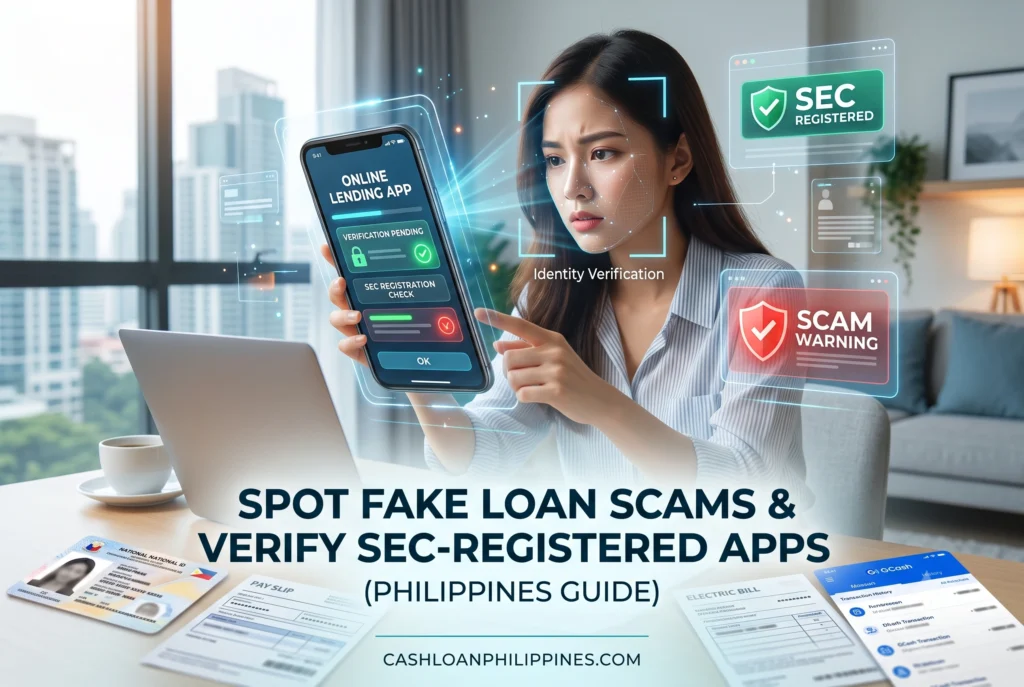
The digital lending space in the Philippines is heavily saturated with unregulated applications disguised as legitimate financial lifelines. If you are reading this, you might be worried about submitting personal data to a fraudulent app, or worse, you are already receiving threatening text messages from a rogue debt collector. The proliferation of illegal online lending applications (OLAs) relies entirely on borrower desperation and a lack of regulatory awareness. These unregulated entities do not care about your credit score; their actual collateral is your personal reputation, which they extract by illegally scraping your phonebook. Taking defensive measures before installing any financial software is mandatory.
Summary:
Verifying SEC registered online lending apps in the Philippines is the only proven defense against illegal data scraping and debt collection harassment. Legitimate platforms hold a valid Certificate of Authority (CA) from the Securities and Exchange Commission and strictly comply with National Privacy Commission (NPC) data rules. Unregistered apps trap borrowers using phantom loans, hidden fees, and predatory 7-day terms while illegally harvesting phone contacts to shame defaulters. To protect yourself, cross-check the app’s developer name with the official SEC database, deny intrusive mobile permissions like READ_CONTACTS, and immediately report abusive collectors to the SEC and NPC.
| Feature / Behavior | SEC-Registered Lending App | Illegal / Unregistered Loan App (OLA) |
| SEC Status | Listed with a valid Certificate of Authority (CA) | Missing from SEC database or uses a fake/revoked CA |
| Mobile Permissions | Requests Camera and Location only (for eKYC) | Demands access to Contacts, SMS, and Call Logs |
| Interest & Terms | Transparent fees; aligns with BSP ceilings (e.g., max 15% per month) | Predatory rates; extremely short 7-day payment windows |
| Collection Practices | Follows SEC Memo 18 (fair collection, normal business hours) | Uses harassment, death threats, and contact-shaming texts |
How do I know if an online loan app is actually legitimate in the Philippines?
You can verify a legitimate lending app by checking if its corporate operator holds an active Certificate of Authority (CA) on the Securities and Exchange Commission (SEC) official website. Registered apps also display transparent interest rates and require standard ID verification without asking for full access to your phone’s address book.
The verification logic behind actual fintech platforms is fundamentally different from scam applications. When you apply through a legitimate, regulated platform – such as those integrated with major e-wallets or established standalone apps – the system conducts a rigorous electronic Know Your Customer (eKYC) process. Regulated platforms utilize optical character recognition (OCR) technology to scan government-issued IDs. For example, submitting a high-quality PhilSys ID will usually clear an automated OCR check within minutes, while a faded UMID card might trigger a manual review or a flat rejection.
Unregistered lending apps operate entirely differently. Because their business model relies on extortion rather than credit risk assessment, they rarely care about the visual clarity of your ID. They will approve almost any application instantly, provided you grant them root-level access to your mobile device’s address book. If an app approves a loan with zero friction but demands total access to your device’s internal storage, you are interacting with a predatory lender.
Where can I find the official SEC list of approved lending companies?
The official list of approved lending and financing companies is updated regularly and published directly on the SEC Philippines website under the Lending and Financing Companies section. Always match the corporate name in the app stores to the exact registered name on this public registry.
Finding this list requires navigating directly to the SEC’s official portal rather than relying on search engine advertisements, which are frequently manipulated by offshore lending syndicates. A critical operational nuance that many borrowers miss is the difference between a corporate name and a “Doing Business As” (DBA) name. An app might be called “FastCash PH” on the Google Play Store, but its registered corporate entity could be “Silver Lending Solutions Inc.”
The SEC provides a master list that includes both the registered corporate name and the exact digital platforms (app names) they are authorized to operate. If an app claims to be registered but you cannot find its specific digital platform name tied to a registered corporation on the SEC list, do not proceed. The SEC regularly issues public advisories and cease-and-desist orders against platforms operating without proper registration.
What is a Certificate of Authority (CA) and why does it matter?
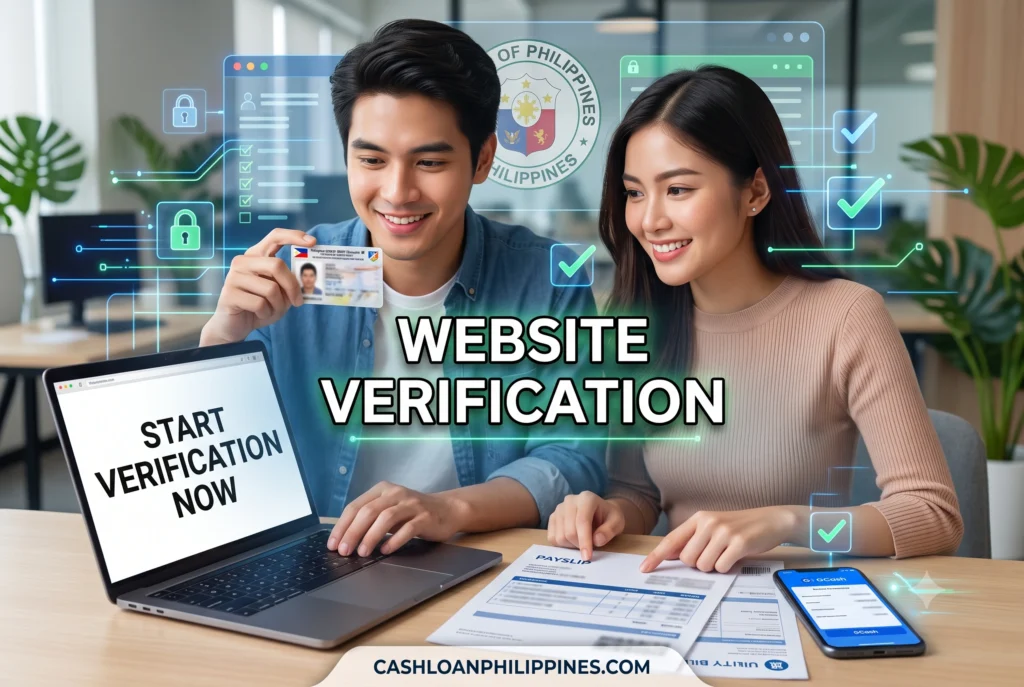
A Certificate of Authority (CA) is a mandatory license issued by the SEC that legally permits a company to operate a lending or financing business in the Philippines. Without a CA, the operation is illegal, rendering their loan contracts void and exposing borrowers to severe data privacy risks.
Borrowers are frequently deceived by a common tactic used by illegal operators: presenting a standard SEC Certificate of Incorporation as proof of legitimacy. A Certificate of Incorporation merely proves a company exists legally; it does not grant them the right to lend money. Only a specific Certificate of Authority (CA) authorizes financial lending activities.
Before interacting with any digital platform, you must verify this specific document to ensure your ID data is secure from unauthorized syndication. Legitimate companies are mandated by the Truth in Lending Act (Republic Act No. 3765) to clearly display their CA Number on their websites, promotional materials, and within the app’s user interface. If an app hides its CA number or provides a generic business permit instead, you are dealing with a high-risk entity.
Why do illegal lending apps ask for my contacts and text messages?
Predatory apps demand access to your contacts and SMS to weaponize your personal network for debt collection and harassment if you miss a payment. They scrape this data during installation to bypass legal collection channels and publicly shame you to your friends, family, and coworkers.
Data scraping is the engine that drives illegal lending operations in the Philippines. When you install an app via a random SMS link or download a rogue APK file outside the official app stores, the software initiates a series of system-level permission requests. While a legitimate banking app requests location access to prevent fraudulent logins and camera access for live selfies, illegal OLAs request technical permissions mapped as READ_CONTACTS, READ_SMS, and READ_CALL_LOG.
These permissions have absolutely zero relevance to assessing your financial creditworthiness. The moment you tap “Allow,” the app executes a background script that copies your entire phonebook, SMS history, and photo gallery to an offshore server. This stolen database becomes their leverage. If you default on a payment, or even if you are just approaching the due date, they deploy automated SMS blasts to your contacts.
How does data scraping lead to OLA harassment and debt shaming?
Once an illegal app copies your phonebook, aggressive collectors mass-text your contacts, falsely claiming you named them as co-makers or guarantors for a loan. This psychological extortion violates the National Privacy Commission (NPC) rules and is a primary tactic used by unregulated operators to force rapid repayments.
The operational behavior of these illegal collection agencies is highly systematic. They do not utilize standard credit reporting bureaus like the Credit Information Corporation (CIC). Instead, they parse the stolen contact list to identify high-value targets – usually people saved as “Mom,” “Boss,” or “HR.”
The collectors then dispatch aggressive, often profane text messages to these specific individuals. A standard harassment message will publicly brand the borrower as a scammer or a thief, threatening legal action against the innocent contact if the borrower fails to pay. This creates immense social pressure. The NPC has explicitly classified these tactics as unauthorized processing of personal information and malicious disclosure, which are criminal offenses under the Data Privacy Act of 2012.
How can I block invasive app permissions on my Android or iPhone?
You must manually navigate to your phone’s App Settings, locate the lending application, and explicitly deny permissions labeled as READ_CONTACTS, READ_SMS, or Call Logs. A legitimate app only needs access to your camera for facial recognition and location services for fraud prevention.
Taking control of your device’s operating system settings is a non-negotiable step in modern digital borrowing. On Android devices, go to Settings > Apps > [App Name] > Permissions. Immediately toggle off access to Contacts, SMS, Telephone, and Storage. If the app refuses to launch or crashes because you denied these specific permissions, delete it immediately. It is functioning as spyware, not a financial tool.
Apple’s iOS sandboxing architecture naturally prevents apps from secretly reading your SMS inbox, but apps can still request access to your Contacts. Navigate to Settings > Privacy & Security > Contacts, and ensure no unverified financial app has the toggle switched on. Blocking these data pathways neutralizes the primary weapon illegal lenders use against consumers.
What should I do if a predatory loan app already accessed my contacts?
If your data has been compromised, immediately revoke the app’s permissions, uninstall the application, and notify your contacts to ignore incoming malicious messages. You must then document the harassment and file formal complaints with the SEC, NPC, and local cybercrime authorities.
Panic is the exact psychological response these predatory lenders rely on to force rapid, unjustified payments. If you realize your data has been scraped, paying the extortionate fees rarely stops the harassment. In many documented cases, paying the initial amount simply signals to the syndicate that you are susceptible to pressure, leading them to demand arbitrary “clearance fees” or “late penalties” while continuing to message your contacts.
Your first operational step is damage control. Disable the app’s permissions and delete the software to prevent further data exfiltration. Next, pre-empt the collectors by posting a brief, factual message on your social media or messaging your close contacts. State clearly that your data was compromised by a malicious app and advise them to block any unknown numbers demanding money on your behalf.
How do I report unfair debt collection practices to the SEC and NPC?
You can report abusive lenders by compiling screenshots of the threatening messages and emailing formal complaints to the SEC’s Corporate Governance and Finance Department and the NPC’s Complaints Division. Regulatory bodies use this evidence to issue cease-and-desist orders and revoke the licenses of violating companies.
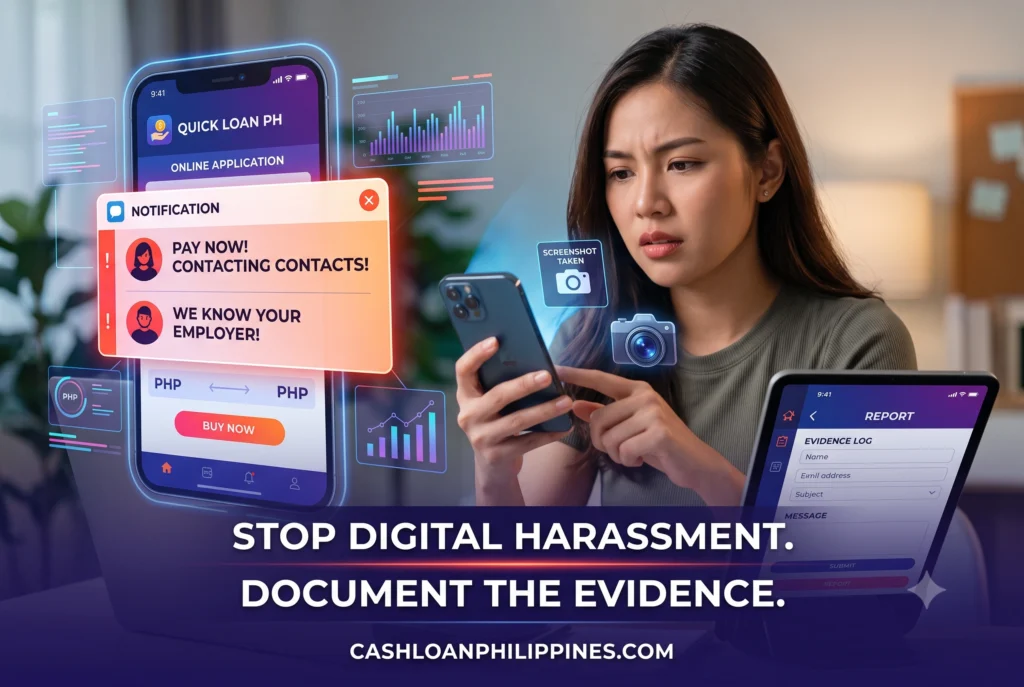
Documentation is critical when dealing with regulatory bodies. Do not delete the threatening text messages or block the numbers until you have taken clear screenshots showing the sender’s details, the timestamp, and the exact nature of the threats.
The SEC specifically monitors violations of Memorandum Circular No. 18, which strictly prohibits unfair debt collection practices, including the use of threats, insults, and contacting individuals not explicitly named as guarantors. Submit your compiled evidence to the SEC’s dedicated complaint portals. Simultaneously, file a data privacy violation report with the NPC. The NPC relies on these specific user reports to track down the data scraping servers and issue sweeping bans against the corporate entities funding these apps.
Can the Cybercrime Investigation and Coordinating Center (CICC) help me stop phantom loans?
The CICC investigates and intercepts organized cyber-extortion operations, including phantom loans where unregistered apps deposit unsolicited money into your e-wallet to force debt obligations. Filing a report via the Inter-Agency Response Center (I-ARC) hotline helps authorities track and dismantle these illicit lending syndicates.
A highly aggressive tactic currently observed in the Philippine market is the “phantom loan.” In this situation, an unregulated app retains your e-wallet or bank details after a rejected application and forcefully deposits a small amount of money (e.g., PHP 1,000) without your consent. A few days later, they demand repayment of double the amount, using your contact list as leverage.
Because this crosses the line from unfair lending into outright cyber-extortion, the CICC becomes the appropriate agency to handle the escalation. You can reach the government’s cybercrime response team by dialing the 1326 hotline. Providing them with the exact transaction reference numbers from your e-wallet and the associated phone numbers of the harassers provides law enforcement with actionable financial trails to freeze the operators’ accounts.
Are 7-day online loans illegal in the Philippines?
While a 7-day loan duration is not explicitly banned by law, the astronomical hidden fees and immediate late penalties tied to these micro-loans often violate the Bangko Sentral ng Pilipinas (BSP) interest rate caps. Legitimate fintech companies typically offer minimum loan tenors of 15 to 30 days to ensure sustainable repayment capabilities.
The 7-day loan structure is mathematically designed for the borrower to fail. Unregistered OLAs frequently market a PHP 5,000 loan, but upon approval, they deduct a massive “processing fee” upfront, disbursing only PHP 3,000 to your account. However, on the 7th day, they demand the full PHP 5,000, plus daily late penalties of 5% to 10% if you miss the midnight deadline.
This behavior is predatory and operates in direct defiance of established banking norms. Legitimate lenders calculate risk based on monthly income cycles, which is why registered platforms align their repayment schedules with standard Philippine payroll dates (the 15th and 30th of the month). If a platform forces a 7-day repayment window, it is a massive red flag indicating an unregulated operation prioritizing rapid capital extraction over sustainable lending.
What are the BSP and SEC rules on predatory interest rates?
The BSP limits nominal interest rates to 6% per month for unsecured micro-loans, while the SEC enforces strict transparency regarding processing fees under the Truth in Lending Act. Apps charging 20% to 30% weekly interest are operating outside regulatory boundaries and are frequently subjected to SEC shutdown orders.
Under BSP Circular No. 1133, a strict ceiling is placed on the interest rates and fees that lending companies can legally charge for specific small-value loans. Legitimate entities program their billing systems to cap the maximum effective interest rate and limit late fees to ensure the debt does not spiral out of control.
Illegal OLAs completely ignore these ceilings. They utilize aggressive compound interest algorithms that can turn a PHP 2,000 debt into a PHP 10,000 liability within a matter of weeks. The SEC mandates that all fees, interest rates, and penalties must be provided to the borrower in a clear Disclosure Statement before the loan is finalized. If an app disburses money without showing you a complete, mathematically sound breakdown of what you owe, they are violating core financial consumer protection laws.
How can I safely borrow money without risking my personal data?
To borrow safely, strictly utilize digital banks, traditional bank apps, or highly vetted e-wallets like Maya or GCash that operate under rigid BSP supervision. Taking the time to follow strict safe online loan application steps prevents severe privacy breaches and ensures fair interest rates.
The safest environment for digital borrowing in the Philippines is within closed-loop financial ecosystems. Fully licensed digital banks and major e-wallet providers possess robust cybersecurity infrastructure and are subject to continuous BSP auditing. They evaluate your creditworthiness based on your actual transaction history, savings behavior, and verified identity, completely eliminating the need to scrape your phone’s contact list.
When you require financial assistance, bypass standalone APK files and social media loan advertisements entirely. Instead, navigate to the dedicated credit sections within your established banking or e-wallet applications. These platforms offer transparent terms, reasonable interest rates, and professional collections processes that respect your data privacy and human dignity.
Conclusion
Navigating the Philippine digital lending ecosystem requires a highly defensive posture. The convenience of instant mobile cash is frequently weaponized by unregistered syndicates seeking to exploit financial vulnerability. Protecting yourself begins at the installation phase – scrutinizing SEC registration data, actively blocking invasive mobile permissions, and recognizing the aggressive hallmarks of 7-day phantom loans. If you encounter abusive debt collection, your immediate response must be documentation and regulatory reporting, never compliance with extortion. Financial safety relies on strict verification, prioritizing regulated banking platforms, and fiercely guarding your digital privacy against predatory operators.
References
- Bangko Sentral ng PilipinasOrganization: BSPResource: Financial Consumer Protection Framework & Circular No. 1133URL: https://www.bsp.gov.ph/
- Securities and Exchange Commission PhilippinesOrganization: SEC PhilippinesResource: List of Registered Lending and Financing CompaniesURL: https://www.sec.gov.ph/
- National Privacy CommissionOrganization: NPCResource: Advisories on Online Lending Applications and Data Privacy Act ViolationsURL: https://www.privacy.gov.ph/
- Cybercrime Investigation and Coordinating CenterOrganization: CICCResource: Inter-Agency Response Center (I-ARC) Public AdvisoriesURL: https://cicc.gov.ph/
Community & User Experience Sources
- r/Philippines & r/DigitalbanksPhOrganization: Reddit CommunitiesResource: Borrower experiences with OLA harassment and reporting proceduresURL: https://www.reddit.com/r/Philippines/
Last Updated on July 1, 2026 by Maria Santos
